

08.10.2026
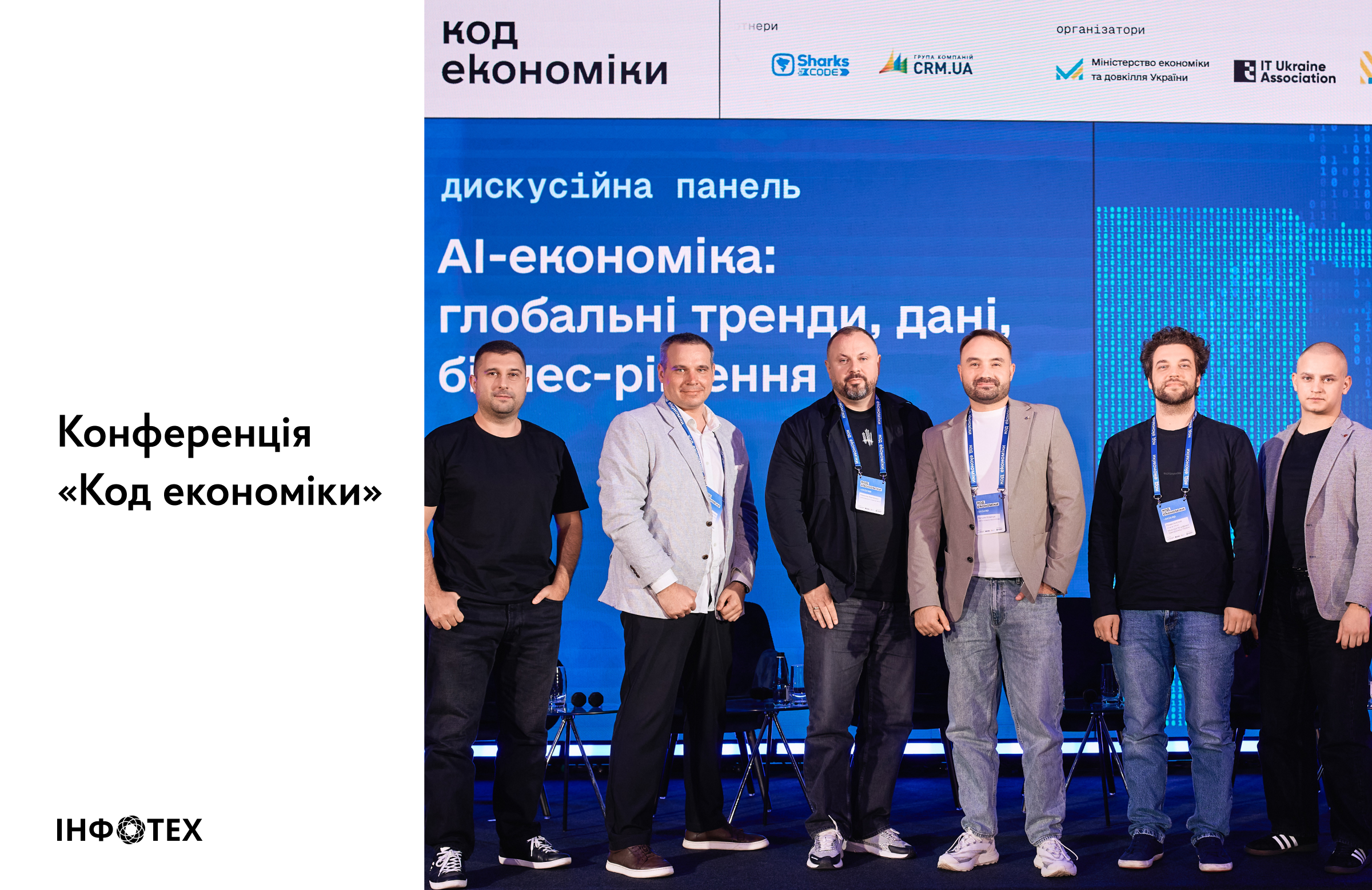
Maksym Khimchenko, Director of the state-owned enterprise “INFOTECH,” participated in the panel discussion “AI Economy: Global Trends, Data, Business Solutions” as part of the “Code of the Economy” conference held in Kyiv.
One of the key topics of the discussion was the practical implementation of artificial intelligence—ranging from identifying processes where AI can already deliver tangible results today to the readiness of IT infrastructure, data protection, and the creation of a secure environment for AI solutions.
Speaking about the experience of the state-owned enterprise “INFOTECH,” Maksym Khimchenko noted that the company has formed a dedicated team to work with artificial intelligence technologies. In the initial phase, specialists focused on identifying practical use cases for large language models and neural network-based algorithms.
“We asked ourselves a simple question: What exactly do we want to achieve using large language models and neural networks? And we concluded that we need to start with specific processes and tasks where we can obtain clear and measurable results. There’s no need to immediately entrust artificial intelligence with decisions that could have legal consequences for people. We should look for practical applications and gradually move toward the systematic implementation of AI solutions,” noted the director of the state-owned enterprise “INFOTECH.”
The panel participants paid special attention to cybersecurity during the implementation of AI-based solutions. For government IT, this issue is of particular importance, as it involves working with sensitive data and information resources that are constantly exposed to cyber threats.
According to Maxim Khimchenko, the security of AI infrastructure cannot be reduced to protecting a single server or software solution. It must be built as a system of independent layers of defense, where a compromise at one level should not automatically grant access to the next.
This approach covers the entire technology chain: trust in physical hardware and suppliers, network isolation, protection of server infrastructure and virtual environments, separate protection of GPUs and the computing environment, control over models and data, as well as monitoring the operation of AI agents and independent oversight of their actions.
“We shouldn’t build a single ‘secure AI server.’ We need to build several independent layers of defense—from physical hardware and the network to GPUs, models, data, and the AI’s own actions. A breach at one level should not automatically allow an attacker to bypass the next,” emphasized Maksym Khimchenko.
Trust is also a fundamental issue in this architecture: artificial intelligence should not independently control its own actions or have unrestricted access to data and keys. Oversight of its operations must be carried out by independent mechanisms, and responsibility for the system’s operation and its results remains with humans.
“When we talk about the public sector’s IT infrastructure, we must keep in mind that we are dealing with sensitive data. Two-factor authentication and other basic security measures have long been standard practice for us. But with the advent of AI solutions, we need to look much deeper—at the entire chain of trust, control, and accountability,” noted the director of the state-owned enterprise “INFOTECH.”
The discussion also covered infrastructure and big data as the foundation for AI development, the readiness of Ukrainian enterprises and companies to implement such technologies, regulatory requirements and the alignment of Ukrainian legislation with the provisions of the EU AI Act, as well as practical case studies of artificial intelligence applications across various industries.
The panel was moderated by Oleksandr Krakovetskyi, CEO of DevRain. Representatives from the Ministry of Economy and Environment of Ukraine, the Ministry of Digital Transformation of Ukraine, KNESS, and Ucloud also participated in the discussion.
The “Code of the Economy” conference brought together over 300 representatives from the public sector, business, and the IT industry. The event was organized by the Ministry of Economy and Environment of Ukraine, the IT Ukraine Association, and the Federation of Employers of Ukraine.

